

4G Tracker vs. Bluetooth Tracker: Which Tracking System Should You Choose
Between a 4G tracker and a Bluetooth tracker, the choice is not always obvious. Both promise to help you find your belongings, but they rely on different technologies, offer different tracking ranges, and different levels of real-time geolocation. Whether you're a fleet manager or an individual looking for the best car tracker, understanding this comparison is essential.
In this article, we will clearly compare 4G trackers vs. Bluetooth trackers, using simple terms, concrete examples, and a summary table. Goal: to help you choose the location beacon that best suits your needs, without unnecessary jargon.
- 4G Tracker: ideal for vehicles, fleets, and long-distance real-time tracking.
- Bluetooth Tracker: perfect for everyday items within short range.

1. 4G Tracker vs. Bluetooth Tracker: The Differences at a Glance
For Google's optimized snippets, here's a very concise GPS tracker comparison between 4G and Bluetooth trackers.
| Criterion | 4G Tracker (GPS) | Bluetooth Tracker |
|---|---|---|
| Main Technology | GPS + mobile network (4G/3G/2G) | Bluetooth Low Energy + nearby smartphone |
| Tracking Range | Theoretically unlimited (as long as there is network coverage) | A few tens of meters (direct) or via user network |
| Location | Real-time GPS geolocation | Approximate location via phone proximity |
| Typical Use | Vehicles, fleet, machinery, trailers, people | Keys, bag, wallet, small luggage |
| Tracker Battery Life | From a few days to several years depending on model and settings | Several months to 1-2 years (low power consumption) |
| Costs | Purchase + subscription (4G data) | One-time purchase (no subscription generally) |
| Relevant for Professional Fleet | Yes, clearly suitable | Very limited, occasional use |
| Relevant for Personal Vehicle | Yes, especially against theft and unauthorized movements | Not suitable for remote car tracking |
2.1. How a 4G Tracker Works, Explained Simply
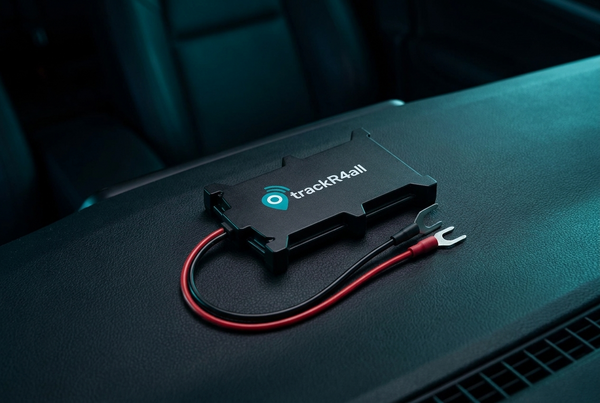
A 4G tracker is a small device equipped with:
- a GPS chip to calculate its position on the planet;
- a SIM card to send this position via the mobile network (4G, sometimes 3G/2G);
- a battery or a connection to the vehicle (12/24 V power supply).
Specifically, the tracker regularly sends its position to a server, which you access via a web or mobile application. This is known as real-time geolocation.
2.2. Advantages of the 4G Tracker
- Virtually unlimited range: As long as there's a network, you can track the device, even hundreds of kilometers away.
- High precision: Thanks to GPS, the position is often accurate to within a few meters.
- Trip history: Very useful for analyzing routes, travel times, stops, etc.
- Advanced alerts: Zone exit, power cut, suspicious movement, speeding...
2.3. Disadvantages/Limitations of the 4G Tracker
- Subscription required for data (monthly or annual).
- Installation sometimes more technical on vehicles (wired connection, discreet placement).
- Higher energy consumption than a simple Bluetooth tracker.
2.4. Recommended Use Cases – Professional
For professionals managing a fleet, the 4G tracker is the most suitable tool. It addresses several needs:
- Tracking of company vehicles (sales representatives, technicians, delivery drivers).
- Optimization of routes and working time.
- Securing high-value assets (machinery, trailers, utility vehicles with equipment).
- Proof of visit or intervention for clients.
2.5. Recommended Use Cases – Individuals
For an individual, a 4G tracker is relevant if you want to:
- protect a car, a motorcycle, or an RV against theft;
- monitor the movements of a young driver;
- find a vehicle parked for a long time or used by multiple people.
Also read our practical guide on installing and choosing the ideal location in the car.
Internal link idea: 4G GPS Tracker: Installation and Placement Guide
3. What is a Bluetooth Tracker?
3.1. How a Bluetooth Tracker Works
A Bluetooth tracker (or Bluetooth tag) is a small, lightweight electronic keychain that connects to your smartphone via Bluetooth. It does not have GPS or a SIM card.
Principle:
- When the tracker is close to your phone (a few tens of meters), the app sees its approximate location.
- Some systems rely on a network of users: if another phone using the same app passes near your tracker, its location can be anonymously reported.
3.2. Advantages of the Bluetooth Tracker
- Low purchase price and no monthly subscription.
- Very simple to use: just attach it to an object, install the app, and that's it.
- Long battery life (several months to 1-2 years) thanks to low power consumption.
- Compact, discreet, lightweight format.
3.3. Disadvantages/Limitations of the Bluetooth Tracker
- Very limited range (a few tens of meters direct).
- Dependence on the smartphone and, sometimes, on the network of other users.
- No real-time geolocation on a map like a 4G GPS.
- Poorly suited for vehicle security or fleet management.
3.4. Recommended Use Cases – Individuals
The Bluetooth tracker is very practical for:
- easily finding your keys, wallet, bag, or luggage at home;
- locating an item left behind within a limited radius (office, car, apartment).
3.5. Recommended Use Cases – Professional
For businesses, a Bluetooth tracker can have occasional uses:
- quickly identify small equipment in a workshop or warehouse;
- find a badge or a small tool in a restricted area.
However, it is not a solution for fleet management or a sufficient security system for vehicles.
4. Detailed Comparison: Range, Precision, Battery Life, Costs
4.1. Range and Location Precision
This is often the differentiating criterion in the 4G tracker vs. Bluetooth tracker debate.
- 4G Tracker: carried by the mobile network, the range is theoretically unlimited (as long as it receives GPS + 4G). Precision is generally within a few meters.
- Bluetooth Tracker: the direct range is a few tens of meters. Precision depends on the nearby phone and is not comparable to GPS.
👉 To track a car across town or country, a Bluetooth tracker is not enough: you need 4G/GPS.
4.2. Battery Life
The tracker's battery life depends heavily on usage and settings.
-
4G Tracker:
- powered by internal battery: a few days to a few weeks with intensive tracking;
- powered by the vehicle + small backup battery: almost unlimited battery life as long as the vehicle is running.
-
Bluetooth Tracker:
- often powered by a coin cell battery;
- can last from several months to over a year.
👉 Summary: Bluetooth wins on pure battery life, but 4G remains unbeatable for overall vehicle tracking.
4.3. Costs: Purchase and Subscription
-
4G Tracker:
- higher purchase cost (robust GPS unit, more complex electronics);
- requires a subscription (SIM card + platform). This is the price of real-time geolocation.
-
Bluetooth Tracker:
- low purchase cost (often less than €50);
- no monthly subscription in most cases.
👉 For an individual who just wants to find their keys, a Bluetooth tracker is more than sufficient. For a professional who wants to track 10 utility vehicles, the 4G subscription is an investment quickly recouped.
Compare this cost to just one day of vehicle downtime or the loss of a stolen utility vehicle: a 4G tracker often pays for itself with a single avoided incident.
Internal link idea: Which subscription to choose for a 4G tracker?
5. Selection Criteria: Professional Needs vs. Personal Needs
5.1. If you are a fleet manager (company)
In B2B, your priorities are often:
- securing vehicles and equipment;
- optimizing costs (fuel, travel time) and productivity;
- meeting commitments to clients (deadlines, interventions);
- having reliable reports and history.
In this context, the choice is clear:
- Prioritize a 4G tracker (GPS) for each key vehicle in your fleet.
- You can potentially supplement with some Bluetooth trackers for small mobile equipment or vehicle keys.
5.2. If you are an individual with one or two vehicles
Your needs are often:
- protecting your car or motorcycle against theft;
- being reassured about a young driver;
- finding a vehicle parked in a large city or during a long trip.
In this case:
- For car security (theft, suspicious movement): a 4G tracker is recommended.
- For everyday items (keys, bag, wallet): a Bluetooth tracker is largely sufficient.
5.3. If you are somewhere in between (small business or freelancer)
Many hybrid situations: artisan with 2 vehicles, consultant who travels often by car, small structure with a few utility vehicles. The good compromise might be:
- one or two 4G trackers for the most critical vehicles;
- Bluetooth trackers for other assets (professional bags, computers, keys, etc.).
List your assets (vehicles, equipment, objects) and classify them from "critical" to "comfort". 4G tracker for the former, Bluetooth for the latter.
Internal link idea: How to protect your car against theft?
6. FAQ – 4G Tracker vs. Bluetooth Tracker
Is a Bluetooth tracker enough to find a stolen car?
No. A Bluetooth tracker relies on proximity to a smartphone and a network of users. For a stolen car, it is highly unlikely to be close enough to a compatible phone. A 4G GPS tracker is essential for this scenario.
Does a 4G tracker work abroad?
Yes, provided the chosen plan includes data roaming in the relevant area. Many 4G trackers work in multiple countries, sometimes even worldwide.
Do 4G trackers consume a lot of battery if the vehicle is rarely driven?
It depends on the settings. You can often choose the frequency of position updates. Fewer points = less consumption. For a rarely used vehicle, the impact remains reasonable, especially if the tracker is powered by the vehicle's battery.
Is a subscription always required for a 4G tracker?
Yes, because you have to pay for the mobile data used by the tracker. This subscription can be included in the provider's offer or managed via your own SIM card. For professional use, an all-inclusive plan simplifies management.
How do I know if a Bluetooth tracker is sufficient for my needs?
If you simply want to find items within a few tens of meters (at home, in the office, in your car), a Bluetooth tracker is sufficient. As soon as you talk about remote tracking, security, or fleet management, you need to switch to 4G/GPS.
Discover Trackr4all 4G trackers suitable for private and professional vehicles
Conclusion: 4G Tracker vs. Bluetooth Tracker, who really wins?
There is no absolute winner in the 4G tracker vs. Bluetooth tracker match. The two technologies address very different needs. The 4G tracker is essential when it comes to vehicles, fleets, real-time tracking, and security. The Bluetooth tracker remains unbeatable for not losing your keys or bag anymore.
For professionals, the choice is clear: 4G trackers for the fleet, possibly supplemented by a few Bluetooth tags for internal items. For individuals, the right combination is often a 4G tracker for the main vehicle and one or two Bluetooth trackers for everyday items.
- Define your priorities: vehicle security, daily convenience, fleet management.
- Choose your technology: 4G for global tracking, Bluetooth for small objects.
- Start with 1 or 2 trackers, then expand if the results are conclusive.
See our complete comparison of the best car trackers
Consult the 4G GPS tracker installation guide
Discover our tips for effectively using a Bluetooth tracker
```
Articles similaires
Easy Finder 4G installation: complete installation guide
This 4G GPS tracker has been designed to remain simple to use, while offering highly reliable real-time geo...

Driver behavior detection: how to spot abnormal driving behavior
Driver monitoring is no longer just for experts: it now concerns both road safety and risk management for ...

Signs of car theft: how to spot suspicious movement of your vehicle
Discovering that your car is not exactly as you left it can be very unsettling. A changed mileage, an advan...